


Understanding the Magic Behind Your Home's Cool Comfort
If you've ever wondered how does central ac work to keep your apartment comfortable on hot San Diego days, you're not alone. Central air conditioning is one of those modern conveniences we rely on daily, yet few people understand the ingenious process happening behind the scenes.
Here's the quick answer: Central AC works by removing heat and humidity from indoor air through a refrigeration cycle. The system pulls warm air from your living space, passes it over cold evaporator coils where refrigerant absorbs the heat, then circulates the cooled air back through your home via ductwork. Meanwhile, the absorbed heat is released outside through the condenser unit.
The process involves four main components working together:
- Thermostat - Signals when cooling is needed
- Indoor unit (evaporator) - Absorbs heat from your air
- Outdoor unit (condenser) - Releases heat to the outside
- Refrigerant - The special fluid that transfers heat between units
Central air conditioning systems were developed in the 1960s and have become the most common whole-home cooling solution in the United States. The beauty of the system lies in its simplicity: it doesn't actually create cold air. Instead, it removes heat from your space and transfers it elsewhere.
The key to the entire process is a remarkable physical principle called phase conversion. When a liquid turns into a gas, it absorbs heat from its surroundings. Central AC systems exploit this law of physics by forcing refrigerant to evaporate and condense repeatedly in a closed loop, moving heat from inside your home to the outdoors.
Understanding how your central air works helps you appreciate the technology keeping you comfortable and can guide better maintenance decisions to keep your system running efficiently.
The Core Components of Your Central AC System
At its heart, a central air conditioning system is an intricate network of specialized components designed to work in harmony to cool your living space. When we talk about how does central ac work, understand these key parts and their roles. Most central AC systems in homes and apartments, like those at The Nash, are split systems, meaning they have both indoor and outdoor components.

The Indoor Unit (Air Handler)
The indoor unit, often called the air handler, is typically located in a closet, attic, or basement—or integrated with your furnace. This is where the magic of heat absorption begins.
- Evaporator Coil: This is perhaps the most crucial part of the indoor unit. Made of copper tubing, the evaporator coil contains the chilled liquid refrigerant. As warm, humid air from your home passes over this coil, the refrigerant absorbs the heat, causing it to evaporate and turn into a low-pressure gas.
- Blower Fan: This powerful fan pulls warm air from your home through the return ducts and pushes the newly cooled air back into your living spaces through the supply ducts. It's the engine that circulates air throughout your entire apartment.
- Air Filter: Before air reaches the evaporator coil, it passes through an air filter. This filter traps dust, pollen, pet dander, and other airborne particles, preventing them from entering the system and improving your indoor air quality.
For residents in our Apartments with Central Air, this indoor unit quietly works its magic, ensuring consistent comfort.
The Outdoor Unit (Condenser)
The outdoor unit, commonly known as the condenser unit, is positioned outside your building. Its primary job is to release the heat absorbed from inside your home back into the outdoor air.
- Compressor: This is the "pump" of the AC system. It takes the low-pressure refrigerant gas from the evaporator coil and compresses it, turning it into a hot, high-pressure gas. This pressurization is key because it raises the refrigerant's temperature above that of the outside air, allowing heat to be released.
- Condenser Coil: Similar to the evaporator coil, the condenser coil is a long, coiled tube. As the hot, high-pressure refrigerant gas flows through this coil, the outdoor fan blows ambient air over it. This process allows the heat to dissipate into the outside air, causing the refrigerant to cool down and condense back into a high-pressure liquid.
- Outdoor Fan: This fan pulls air into the outdoor unit, drawing it over the condenser coil to help release the heat.
The Supporting Cast
Beyond the main indoor and outdoor units, several other components are vital to understanding how does central ac work.
- Thermostat: This is your control center. It's the device you interact with to set your desired indoor temperature. When the thermostat detects that the indoor temperature has risen above your setting, it signals the central AC system to begin the cooling cycle. Modern apartments often feature Apartments with Smart Home Technology thermostats, allowing for even greater control and efficiency.
- Refrigerant: This special chemical compound is the lifeblood of your AC system. It continuously cycles between liquid and gas states, absorbing heat indoors and releasing it outdoors. Without refrigerant, your AC wouldn't be able to transfer heat effectively.
- Refrigeration Lines: These insulated copper tubes connect the indoor and outdoor units, forming a closed loop through which the refrigerant circulates. One line carries the low-pressure gas from the evaporator to the compressor, and the other carries the high-pressure liquid from the condenser back to the evaporator.
- Ductwork: This network of channels, usually hidden within walls, ceilings, and floors, acts as the air delivery system. It carries warm air from your rooms to the indoor unit and distributes cooled air back throughout your home.
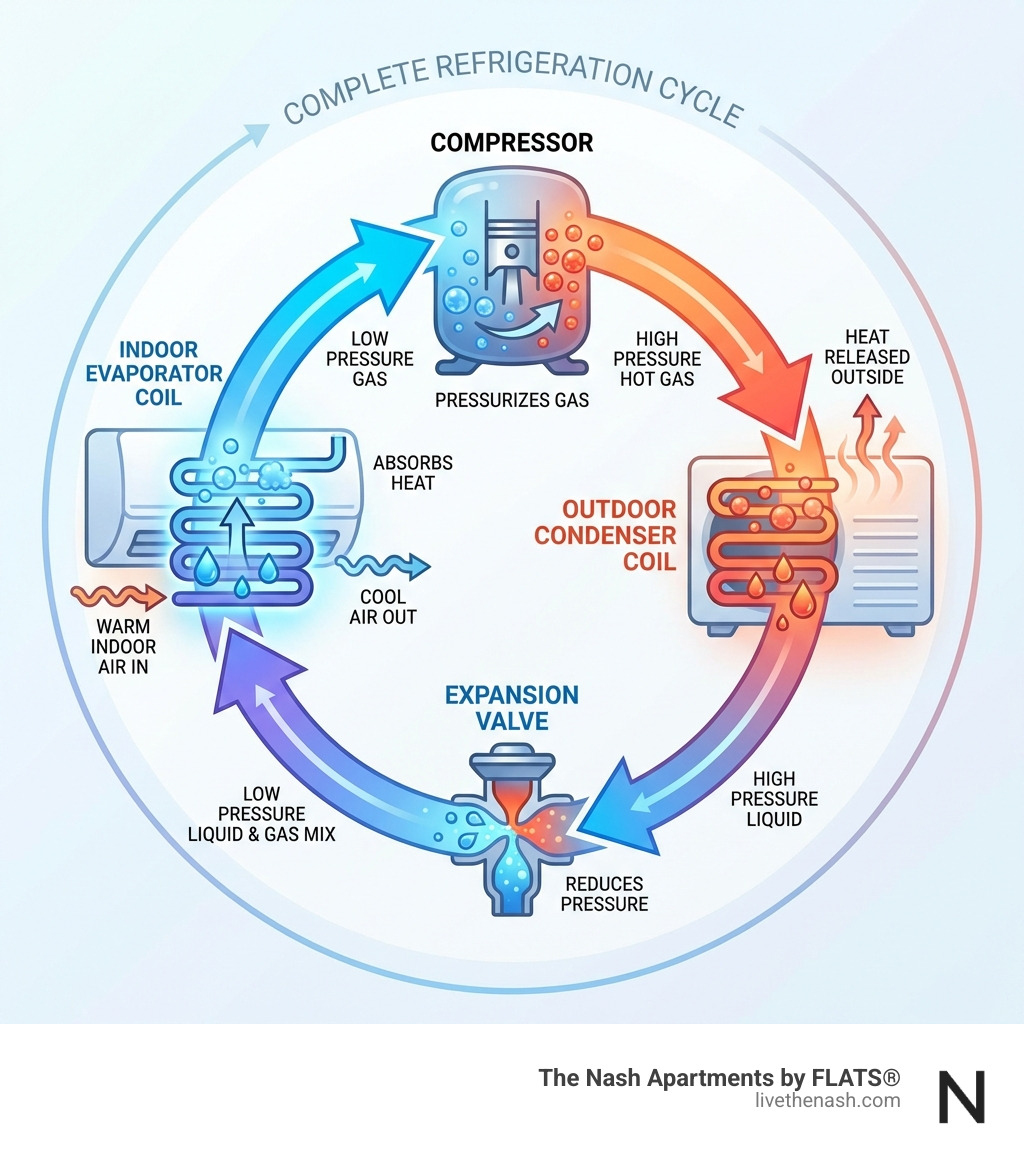
How Does Central AC Work? The Step-by-Step Refrigeration Cycle
Now that we've explored the main components, let's trace the journey of heat removal through the central AC system. This continuous process, known as the refrigeration cycle, is the core of how does central ac work.
Step 1: The Thermostat Signals for Cool Air
Our journey begins with you setting your desired cool temperature on the thermostat. Let's say you've set it to a comfortable 72°F. When the indoor temperature rises above this setting, the thermostat acts as the system's brain, sending an electrical signal to both the indoor and outdoor units to kick into action. This seamless automation is a hallmark of Apartments with Modern Amenities, ensuring your comfort without constant adjustments.
Step 2: Absorbing Heat Indoors
Once activated, the indoor blower fan starts to pull warm, humid air from your living space through the return air ducts. This air first passes through the air filter, which catches dust and debris. Then, the filtered warm air flows over the cold evaporator coil.
Inside this coil, the refrigerant is a low-pressure liquid. As the warm air encounters the cold coil, the refrigerant absorbs the heat from the air. This heat absorption causes the liquid refrigerant to undergo a "phase conversion," turning it into a low-pressure gas. This process is highly efficient at removing heat and is fundamental to how the AC process works. The now-cooled and dehumidified air is ready to be circulated back into your home.
Step 3: Pressurizing and Moving the Heat
The refrigerant, now a low-pressure gas laden with the heat absorbed from your indoor air, travels through the refrigeration lines to the outdoor unit. Here, it enters the compressor. The compressor's job is to increase the pressure of this refrigerant gas. This pressurization also significantly raises the temperature of the refrigerant, turning it into a hot, high-pressure gas. Think of it as concentrating the collected heat.
Step 4: Releasing Heat Outdoors
From the compressor, the hot, high-pressure refrigerant gas moves into the outdoor condenser coil. The outdoor fan simultaneously begins to draw ambient air over these coils. As the hotter refrigerant gas comes into contact with the cooler outdoor air, the heat is transferred from the refrigerant to the outside environment. This heat expulsion causes the refrigerant to cool down and undergo another phase conversion, condensing back into a high-pressure liquid. It has now shed its absorbed heat and is ready to start the cycle anew.
Step 5: Distributing Cool, Dry Air
The high-pressure liquid refrigerant then travels back indoors through the refrigeration lines to an expansion valve, which reduces its pressure and temperature, preparing it to absorb more heat. Meanwhile, the blower fan in the indoor unit takes the air that has been cooled and dehumidified by the evaporator coil and pushes it through your home's ductwork. This cool, dry air is then delivered through vents into various rooms, providing consistent and refreshing comfort throughout your entire apartment. This efficient distribution is key to enjoying Modern Living San Diego.
This entire refrigeration cycle repeats continuously, maintaining your desired indoor temperature and humidity levels.
Split System vs. Packaged System: What's the Difference?
While the core principles of how does central ac work remain the same, there are two primary configurations for central air conditioning systems: split systems and packaged systems. Understanding their differences can help you appreciate the design choices in various properties.
Split-System Air Conditioners
Split systems are the most common type of central air conditioning and what we typically refer to as "central air." As the name suggests, they consist of two main parts:
- Indoor Unit: This unit typically includes the evaporator coil, blower fan, and air filter, often housed within or alongside a furnace or air handler.
- Outdoor Unit: This unit contains the compressor, condenser coil, and outdoor fan.
These two units are connected by refrigeration lines and electrical wiring. The primary benefit of a split system is its ability to minimize noise, as the loudest components (compressor and outdoor fan) are located outside. This configuration is widely used in residential homes and apartment complexes, including those offering Central Air Conditioning basics.
Packaged Air Conditioners
In contrast, a packaged AC system houses all the main components—the evaporator coil, blower fan, compressor, and condenser coil—within a single, self-contained unit. These units are typically installed on a rooftop or on a concrete slab next to the building.
Packaged systems are often chosen when indoor space for an air handler or furnace is limited, or for commercial applications. In the United States, packaged systems are particularly common in the southern and southwestern areas of the country, such including regions like San Diego, due to their space-saving design and ease of installation in certain building types.
Comparing Split Systems and Packaged Systems
| Feature | Split System | Packaged System |
|---|---|---|
| Key Components Location | Indoor unit (evaporator, blower) and Outdoor unit (compressor, condenser) | All components housed in a single outdoor unit |
| Common Use Cases | Residential homes, apartments | Commercial buildings, homes with limited indoor space |
| Space Requirements | Requires space for an indoor unit (e.g., closet, attic) | Space-saving, often rooftop or ground-level installation |
Beyond Cooling: The Added Benefits of Central Air
While the primary function of central AC is to cool your home, its benefits extend far beyond just temperature control. Understanding these additional advantages further explains how does central ac work to improve your overall living environment.
How does central AC work to improve indoor air quality?
We often think about outdoor air pollution, but studies estimate that the air you breathe inside your home can be more polluted than the air outside. Central AC systems offer significant improvements to indoor air quality, which is vital for a healthy living space.
- Air Circulation and Filtration: As your system draws air from your rooms, it passes it through an air filter. This filter captures airborne particulates like dust, pet dander, pollen, and other allergens. Regularly changing your air filter ensures that these contaminants are effectively removed from the air you breathe. This continuous filtration is a basic form of improved indoor air quality, as detailed in this EPA guide on indoor air cleaners.
- Humidity Control: Beyond just cooling, central AC systems actively dehumidify the air. The cold evaporator coil causes moisture in the warm air to condense on its surface, which is then drained away. By reducing indoor humidity, the system makes the air feel more comfortable even at slightly higher temperatures and discourages the growth of mold and mildew.
- Reducing Airborne Contaminants: By constantly circulating and filtering air, central AC helps to reduce the concentration of various airborne pollutants, contributing to a fresher and cleaner indoor environment.
Why Choose Central Air?
Choosing central air conditioning offers a multitude of benefits that contribute to a superior living experience, especially in a vibrant city like San Diego.
- Whole-Home Comfort: Unlike window units that only cool a single room, central AC provides consistent, even cooling throughout your entire home. This means every room in your apartment can maintain your desired temperature, eliminating hot and cold spots.
- Consistent Temperature: Our systems are designed to regulate the cooled air in different ways, ensuring that your living space remains at a comfortable, steady temperature, rather than fluctuating wildly.
- Quiet Performance: With the loudest components (the compressor and outdoor fan) located outside, central AC systems operate much more quietly indoors compared to other types of air conditioners. This allows for a more peaceful and relaxing home environment, perfect for enjoying Luxury Living San Diego.
- System Efficiency: Modern central AC units are designed for energy efficiency, helping to manage energy consumption while providing powerful cooling. Their ability to cool an entire home efficiently makes them a smart choice for long-term comfort.
Frequently Asked Questions about Central Air Conditioning
We've covered the basics of how does central ac work, but you might still have some lingering questions. Let's tackle a few common ones.
What is refrigerant and why is it important?
Refrigerant is a special chemical compound that plays a vital role in the air conditioning process. It's the substance that absorbs heat from your indoor air and releases it outside. Its importance lies in its unique ability to easily change between a liquid and a gas state at relatively low temperatures. This "phase conversion" is what allows it to efficiently transfer heat.
The chemical composition of refrigerants has evolved significantly over the years. Older formulas, like those containing chlorine, were found to contribute to ozone depletion. Thanks to international agreements like the Montreal Protocol, modern refrigerants are designed to be more environmentally friendly, with a lower global warming potential. You can learn more about the environmental impact of refrigerants from the EPA.
How does central AC work with a furnace?
Many central AC systems are integrated with a furnace, forming a complete HVAC (Heating, Ventilation, and Air Conditioning) system. While the AC handles cooling and the furnace handles heating, they often share several components:
- Shared Blower Fan: The same powerful blower fan in the indoor air handler unit is used to circulate both cooled air from the AC and heated air from the furnace through your home's ductwork.
- Shared Ductwork: The existing network of ducts is used for both heating and cooling, making it a cost-effective and efficient way to deliver conditioned air throughout your apartment year-round.
- Shared Thermostat: A single thermostat typically controls both the heating and cooling functions, allowing you to switch between modes as needed to maintain comfortable indoor temperatures regardless of the season.
This integration provides seamless, year-round climate control, making your home comfortable whether it's a warm San Diego summer day or a cooler winter evening.
How often should I change my air filter?
Changing your air filter regularly is one of the simplest yet most effective ways to ensure your central AC system runs efficiently and maintains good indoor air quality. As air passes through the filter, it collects dust, pet dander, pollen, and other particles. Over time, a dirty filter can restrict airflow, making your system work harder, which can lead to increased energy consumption and reduced cooling performance.
A general guideline is to change your air filter every 1 to 3 months. However, this can vary depending on several factors:
- Filter Type: Some high-efficiency filters can last longer.
- Pet Ownership: Homes with pets tend to accumulate more pet dander and hair, requiring more frequent changes.
- Allergies: If anyone in your household suffers from allergies, more frequent changes can help improve air quality.
- Occupancy: Apartments with more residents or frequent activity might require more frequent changes.
Regular filter changes not only keep your air clean but also protect your AC system from dust buildup on its coils, helping it operate efficiently and preventing potential breakdowns.
Conclusion: The Comfort of Modern Climate Control
Understanding how does central ac work reveals a sophisticated yet neat process that efficiently transfers heat from your living space to the outdoors. Through the continuous cycle of refrigerant changing states, the coordinated efforts of indoor and outdoor units, and the precise control of a thermostat, central air conditioning delivers consistent, whole-home comfort.
Beyond just cooling, these systems play a crucial role in improving indoor air quality by filtering out particulates and controlling humidity. This creates a healthier, more pleasant environment for you and your household.
At The Nash Apartments, we understand the importance of a comfortable living space, especially in a city like San Diego. Our apartments are equipped with modern central air conditioning systems to ensure our residents enjoy optimal temperatures and superior indoor air quality year-round. Experience the convenience of premium building features and the ultimate comfort of modern climate control by exploring our full list of amenities.