

Why EV Chargers in Apartments Are the New Standard
Finding ev chargers in apartments has quickly shifted from a rare luxury to an absolute necessity for modern renters.
If you are hunting for an apartment that supports your electric vehicle, here is a quick guide to what you should look for:
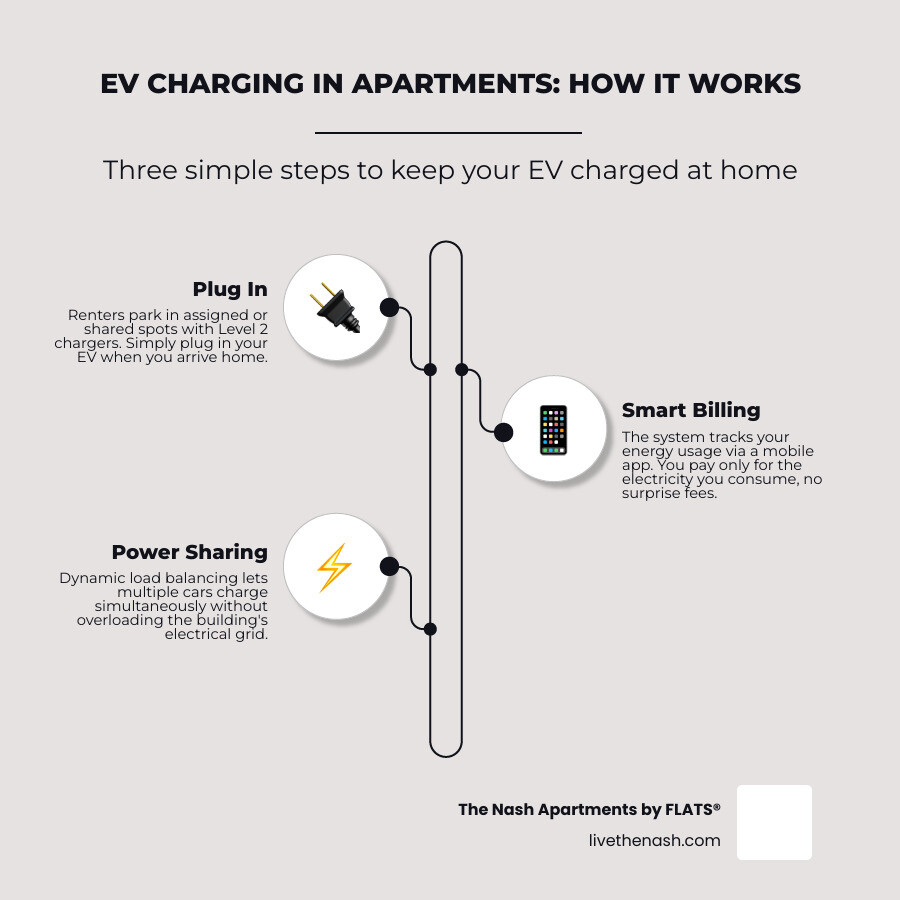
- Charging Speed: Look for Level 2 chargers. These deliver enough power to fully charge your vehicle overnight. Level 1 is often too slow, and DC fast chargers are rarely installed in residential areas.
- Access Rules: Find out if the chargers are located in assigned, private parking spaces or in shared community spots.
- Billing Methods: Most properties use smart systems that track your energy use through a mobile app. This ensures you only pay for the electricity you actually use.
- Power Reliability: Top buildings use smart power-sharing technology. This lets multiple cars charge at the same time without overloading the building's electrical grid.
Most EV owners prefer to plug in where they sleep. In fact, over 70% of drivers want to charge their vehicles at home.
As more people make the switch to electric cars, renting should not mean compromising on convenience. Modern properties are rapidly upgrading to meet this demand, making it easier than ever to live sustainably.
Here is a simple look at how properties are setting up their systems to keep your battery full:
Why Property Owners Benefit from EV Chargers in Apartments
For property owners and managers, integrating electric vehicle infrastructure is no longer a futuristic concept—it is a smart, forward-looking business strategy. As of July 2026, electric vehicle adoption is soaring. In North America, EV sales are predicted to reach 40% by 2030 and climb over 60% by 2035. This massive wave of adoption means a huge portion of the renter market will soon require home charging options.
Unmatched Resident Attraction and Retention
Offering on-site charging is one of the most effective ways to stand out in a competitive market. Research shows that 58% of renters are willing to pay more to live in a community offering EV charging. Because 71% of EV drivers prefer to charge at home, properties that offer this amenity immediately become the preferred choice for high-value, tech-savvy residents.
Furthermore, demographic shifts are driving this demand. About 63% of millennials are likely to consider purchasing an EV instead of a traditional vehicle, while 47% of millennials, 41% of Gen Zers, and 38% of Gen Xers want an EV as their next vehicle purchase. By installing ev chargers in apartments, property owners can capture these forward-thinking demographics and keep them happy for the long term.
Boosting Property Value and Net Operating Income (NOI)
Adding charging infrastructure directly enhances a property's long-term asset value. Committing to sustainability helps properties stay ahead of evolving local building codes and green regulations. Many jurisdictions are beginning to mandate that up to 20% of parking spaces in new developments must be "EV-ready." By installing these systems now, owners future-proof their buildings against upcoming compliance requirements.
Additionally, smart chargers can serve as new, consistent revenue streams. Property managers can set custom fee structures—such as charging visitors a higher rate while offering residents structured plans. This transforms standard parking spaces into active revenue-generating assets, boosting overall Net Operating Income. This elevated profile aligns perfectly with what modern renters expect from apartments with modern amenities.
Meeting Modern Sustainability Goals
Modern consumers care deeply about the environment. Around 88% of consumers want brands to help them live sustainably. By providing EV charging infrastructure, property owners make a tangible commitment to reducing greenhouse gas emissions. For instance, across some of the nation's leading shared charging networks, users have collectively saved over 5 million gallons of gas and reduced carbon emissions by more than 71 million pounds—the equivalent of planting over 129,000 trees. This environmental impact is a powerful marketing tool when showcasing luxury apartment amenities ultimate guide and other upscale apartment amenities.
The Ultimate Guide to EV Chargers: Apartments and Multifamily Buildings
Understanding the technical options is essential when evaluating EV charging setups in multifamily communities. Not all chargers are created equal, and different setups serve different residential needs.
Level 1 Charging: The Baseline
Level 1 charging uses a standard 120-volt household outlet. While it is simple and requires no specialized electrical upgrades, it is incredibly slow. It typically adds only 2 to 5 miles of range per hour of charging. For renters with a daily commute of under 40 miles who can leave their car plugged in for 8 or more hours overnight, Level 1 can be "good enough" as a temporary solution. However, it is rarely sufficient as a primary community-wide charging solution.
Level 2 Charging: The Gold Standard
Level 2 charging is the industry standard for multifamily residential properties. Operating at 240 volts, these chargers deliver between 7kW and 22kW of AC power, which is up to 15 times faster than a standard outlet. A typical Level 2 charger adds 20 to 35 miles of range per hour, allowing residents to get a full charge easily in 3 to 8 hours while they sleep.
Because 80% of EV charging happens at home, Level 2 systems strike the perfect balance between charging speed, electrical grid capacity, and installation practicality. They are highly efficient, reliable, and compatible with all major electric vehicle models. Property managers looking to install these systems often opt for commercial-grade Apartments & Condos - EV Chargers and software packs to handle the high demand of shared environments, making apartments with ev chargers highly sought after.
DC Fast Charging (Level 3)
DC Fast Chargers (DCFC) bypass the vehicle's onboard charger to deliver high-voltage direct current directly to the battery. These powerful stations can charge an EV to 80% in as little as 20 to 40 minutes. While incredibly fast, they require massive electrical infrastructure, heavy-duty utility upgrades, and significant space. Because of these constraints and the high demand they place on the local power grid, DC Fast Chargers are rarely installed inside residential parking garages and are instead suited for commercial highway plazas or public charging hubs.
How Landlords Manage Billing and Power Sharing
Managing a shared resource like electricity requires smart technology. Property managers cannot manually track who plugs in and for how long. Fortunately, modern software and hardware integrations make managing shared charging networks simple and automated.
Dynamic Load Balancing and Power Sharing
One of the biggest hurdles for older apartment buildings is limited electrical capacity. Upgrading transformers, main panels, and utility lines can be incredibly intensive. This is where dynamic load balancing and power-sharing software come to the rescue.
Power-sharing technology allows multiple charging stations to run on a single electrical circuit. The system intelligently monitors the building's total energy consumption in real time and automatically adjusts the power output to each active charger. If only one car is plugged in, it receives maximum power. If five cars plug in simultaneously, the system distributes the available power safely among them. This dynamic optimization allows properties to install three to five times more chargers on their existing electrical grid without needing to upgrade their main panel.
Smart Access Control and Personalized Billing
To ensure fairness, modern charging stations utilize cloud-based management software. Residents can access the chargers using RFID cards, key fobs, or a dedicated smartphone app. This smart access control ensures that only verified residents can use the stations.
The central software tracks real-time charging statistics, energy consumption, and duration for each user. Landlords can then easily set up automated, personalized billing. Residents are billed directly through the app on a pay-per-use basis (per kilowatt-hour or per hour), eliminating any manual utility calculations for the property staff. For properties featuring apartments with smart home technology, these automated systems integrate beautifully into the overall digital resident experience. You can explore more about how these systems connect by reading our apartments smart home features guide.
With the right setup, such as Residential EV Charging Solutions | Home & Condo | GDON, property managers can easily monitor usage, track greenhouse gas reductions, and keep the community running smoothly.
The Installation Checklist for Multi-Unit Dwellings
Installing EV charging infrastructure in a multi-unit dwelling requires careful planning, collaboration, and execution. Property owners should follow a structured approach to ensure a seamless installation.
1. Electrical Site Assessment
Before buying any hardware, a certified electrical contractor must conduct a thorough site survey. This assessment determines the property's current power capacity, evaluates the layout of the parking garage or lot, and identifies where the chargers can be physically placed.
2. Design and Hardware Selection
Based on the site survey, property managers can design the ideal layout. It is highly recommended to install dual-port chargers to maximize parking efficiency, allowing two vehicles to share a single pedestal. Choosing hardware that is Open Charge Point Protocol (OCPP) compliant ensures that the physical chargers can integrate with various software networks in the future.
3. Leverage Utility Rebates and Funding
Upfront installation costs can be significantly offset by researching local, regional, and federal incentives. In San Diego, CA, the San Diego Gas & Electric (SDG&E) Power Your Drive program has been a major driver for local multi-family electrification. These utility programs often provide "make-ready" infrastructure, meaning the utility handles and funds the necessary electrical upgrades up to the point of connection, leaving the property to only cover the charger units. Many programs also offer substantial rebates covering equipment purchase and ongoing maintenance.
Real-world examples, such as those highlighted in the Case Study | Harvard Regency and the EV Station Installation Case Study – The Row at Red Hill, show that properties partnering with turnkey installation providers can frequently fund a massive portion of their projects through local green energy initiatives and utility rebates.
4. Permitting and Professional Installation
Once funding is secured, the installation team will handle local municipal permitting and physical construction. Running conduit, mounting pedestals, and hardwiring the chargers should always be done by vetted professionals to ensure code compliance and safety.
5. Software Commissioning and Training
Finally, the system is connected to the cloud network, access controls (like RFID or mobile apps) are set up, and the property management team is trained on how to use the administration dashboard. Turnkey solutions like those offered by MDU Apartments & Condos | NovaCHARGE make this entire process effortless from concept to daily operations.
Renter Guide: Navigating EV Charging as a Tenant
If you are a tenant who owns or is planning to buy an electric vehicle, navigating the charging landscape in an apartment can feel daunting. However, you have more options and leverage than ever before.

How to Request EV Chargers: Apartments Tenant Guide
If your current building does not have charging stations, you can advocate for them. Many states, including California, have enacted "Right to Charge" laws. These legal protections generally state that landlords cannot unreasonably deny a tenant's request to install an EV charger in their dedicated parking space, provided the tenant covers the installation and electricity costs and meets safety requirements.
When proposing an installation to your landlord, come prepared with a professional, solution-oriented proposal:
- Highlight the Benefits: Remind them that adding EV chargers increases the property's market value, attracts high-value residents, and helps future-proof the building.
- Provide Information on Incentives: Show them that local utility programs, like SDG&E initiatives in San Diego, can cover a large portion of the installation costs.
- Keep It Low-Effort: Present a turnkey installation option so they see that the project will require minimal daily management from their staff.
Shared Infrastructure for EV Chargers: Apartments Solutions
If dedicated personal chargers are not feasible, look for properties that offer shared community chargers. These are typically located in common-area parking spaces and can be reserved or used on a first-come, first-served basis.
If on-site options are temporarily unavailable, you can build a reliable charging routine by combining workplace charging (using your office as your primary charging "home base") and utilizing public Level 2 or DC fast-charging networks during your weekly errands. However, nothing beats the convenience of waking up to a fully charged battery right at home.
Frequently Asked Questions About Apartment EV Charging
What is the difference between Level 2 and DC fast charging?
Level 2 charging uses 240-volt AC power and is the standard choice for residential and overnight charging. It charges a vehicle fully in 3 to 8 hours. DC Fast Charging (Level 3) uses high-voltage direct current to charge an EV to 80% in under 40 minutes. DC Fast Chargers require massive utility infrastructure and are generally too powerful and intensive for residential apartment buildings.
How does dynamic load balancing prevent electrical overloads?
Dynamic load balancing is a smart software solution that monitors the building's total electrical demand in real time. When multiple EVs plug in to charge, the software automatically distributes the available electrical current safely among all active vehicles. This prevents the system from exceeding the building's maximum power capacity and eliminates the need for expensive electrical panel upgrades.
Are there utility programs to help fund apartment EV charging?
Yes, many major utility providers offer dedicated programs to support multifamily properties. In San Diego, programs like SDG&E's Power Your Drive help cover the costs of "make-ready" infrastructure, utility upgrades, and physical equipment. Federal tax credits and regional clean energy grants are also widely available to help properties transition to green energy.
Conclusion
As we progress through 2026, electric vehicles are cementing their place as the future of transportation. For renters in Southern California, living in a community that supports this lifestyle is essential.
At The Nash Apartments by FLATS®, we are proud to offer a premium living experience that seamlessly blends style, comfort, and modern sustainability. Located at the vibrant intersection of San Diego's University Heights and North Park neighborhoods, our community is designed for those who appreciate upscale living and convenient modern amenities.
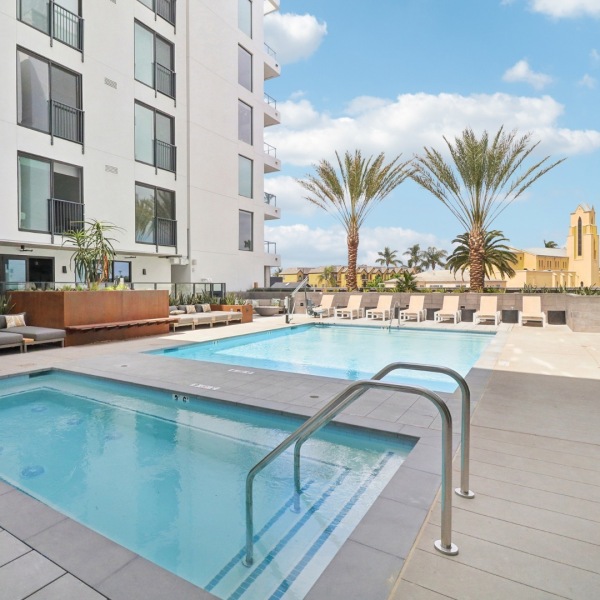
Whether you want to relax at our rooftop lounge, unwind in our pool and hot tub, stay active in our two-story fitness center, or utilize our co-working spaces, we have everything you need. Best of all, our on-site EV charging stations mean you can plug in overnight and head out each morning fully charged and ready to explore San Diego.
If you are looking for apartments with electric car charging in a highly desirable neighborhood, we invite you to explore our community. Check out our university heights san diego apartments guide and our overview of north park luxury apartments to learn more about our incredible local dining, nightlife, and culture.
Ready to see it for yourself? Schedule a tour today and find your perfect home at The Nash.