

History and Architectural Character of University Heights San Diego
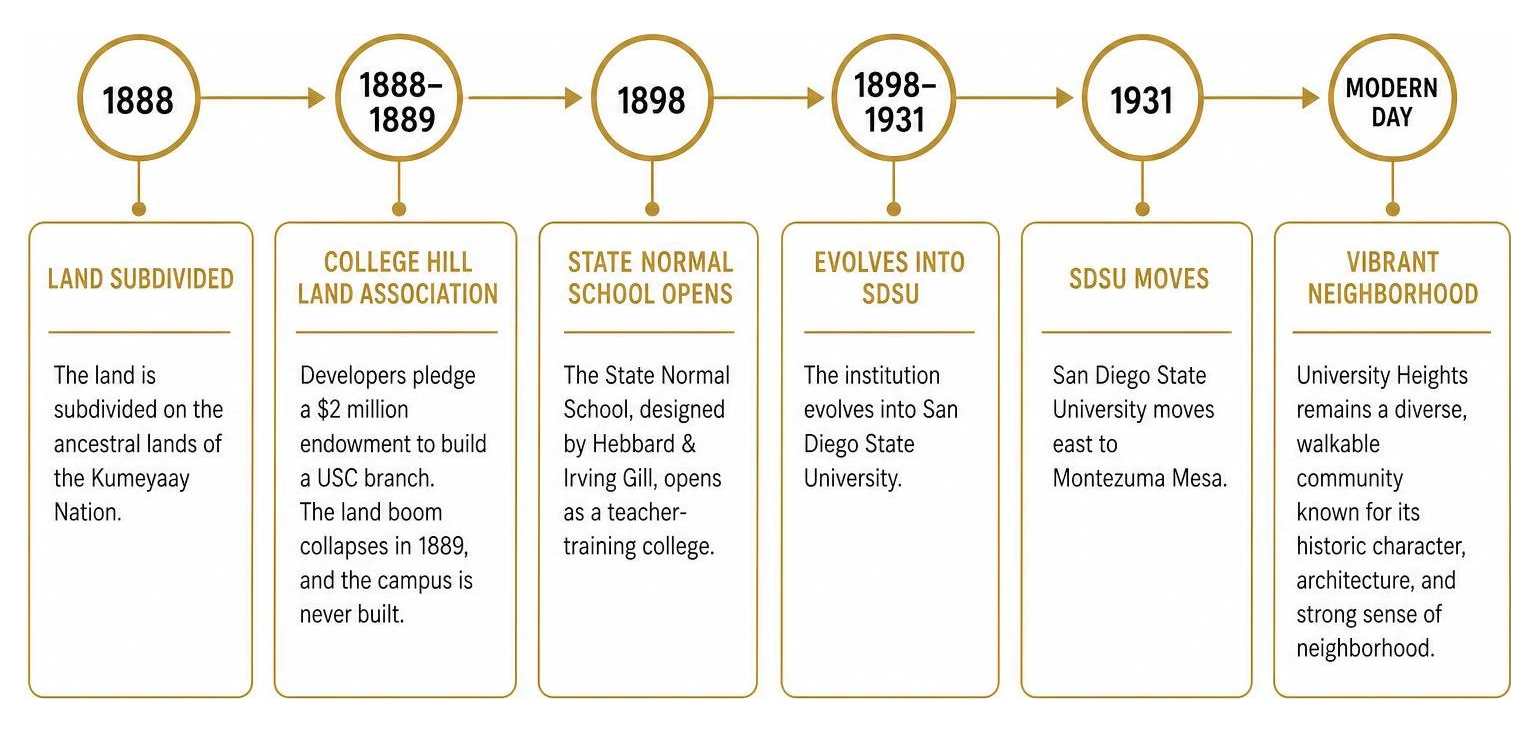
To truly understand university heights san diego, we have to go back to 1888 when the land was first subdivided. The story begins on the ancestral lands of the Kumeyaay Nation, who lived in harmony with the region's dynamic canyons and mesas long before San Diego's rapid 19th-century boom.
During the late 1880s real estate push, developers formed the College Hill Land Association and pledged a $2 million endowment to build a San Diego branch of the University of Southern California. Though that university campus never materialized due to the collapse of the land boom in 1889, higher education did eventually find a home here. In 1898, the State Normal School—a teacher-training college designed by famed local architects William S. Hebbard and Irving Gill—opened its doors in the neighborhood. That institution eventually evolved into San Diego State University (SDSU) before moving east to Montezuma Mesa in 1931.
Beyond education, early visitors and residents were drawn to local attractions like Mission Cliff Gardens, developed by San Diego Cable Railway along the mesa edge overlooking Mission Valley. Landscape superintendent John Davidson cleared stubborn adobe clay and scores of hard stones, turning them into durable cobblestone terraces, lily ponds, and retaining walls. Adjacent to the gardens was the Harvey Bentley Ostrich Farm, where visitors could view and even ride giant ostriches, whose valuable feathers were processed at a nearby silk mill.
As an early "streetcar suburb," the area expanded rapidly alongside transit infrastructure. Electric streetcars connected the neighborhood directly to central San Diego, allowing early commuters easy movement between residential blocks and urban job centers. You can read more about these fascinating beginnings through the History of University Heights.
Historic Landmarks and Preservation
The architectural landscape of university heights san diego reflects its evolution across the early 20th century. Architectural styles throughout the neighborhood range from classic Craftsman bungalows and Prairie-style homes to elegant Spanish Colonial Revival court buildings.
A prime example of local preservation is Shirley Ann Place, a designated historic district featuring a charming cul-de-sac of 1920s Spanish Colonial Revival bungalows. Another critical landmark is the Georgia Street Bridge, which spans a canyon to connect the area with neighboring communities.
Key historical milestones and preservation efforts include:
- 1913 Trolley Barn Construction: A heavy reinforced brick building erected to store and repair Class 1 streetcars operated by the San Diego Electric Railway.
- Trolley Barn Park Establishment: After trolley service ceased in 1939 and the building was demolished in 1980, local residents successfully organized to convert the 8.5-acre site into a public park rather than a high-density condo complex in 1991.
- Historic Property Designations: Many private homeowners leverage programs like the California Mills Act to preserve historic residential facades while qualifying for property tax relief.
Local history is actively safeguarded by organizations such as the University Heights Historical Society, ensuring that the stories and structures of early San Diego remain intact. For additional municipal context, visit University Heights, San Diego.
Geographic Boundaries, Transit, and Commercial Corridors
Sitting proudly on the mesa above Mission Valley, university heights san diego enjoys a central location within the city's urban ring. The physical borders of the neighborhood are well-defined:
- Northern Boundary: The scenic rim of the Mission Valley mesa
- Southern Boundary: Lincoln Avenue
- Eastern Boundary: Texas Street (bordering Normal Heights)
- Western Boundary: Bordering Hillcrest near Park Boulevard
Public transit connectivity is robust, anchored by Metropolitan Transit System (MTS) Bus Routes 6 and 11, which run through the heart of the community along Park Boulevard and Adams Avenue. Drivers enjoy convenient freeway access to Interstate 8, Interstate 805, and State Route 163, providing drive times of roughly 15 minutes to downtown San Diego.
Street parking varies throughout the area; while side streets offer free parking options, spots along primary business strips can fill up quickly during peak dining hours and weekend events. For a detailed breakdown of residential living, check out our University Heights San Diego Rentals Guide.
Navigating the Commercial Corridors of University Heights San Diego
The social and economic pulse of the neighborhood flows along two primary thoroughfares: Park Boulevard and Adams Avenue. The intersection of these two corridors features the neighborhood's overhead street sign, designed by artist Kevin Whaley and dedicated in 1997.
Along Park Boulevard and Adams Avenue, you will find an eclectic mix of independent businesses:
- Independent Coffee Houses: Local institutions like Lestat's Coffee House on Adams Avenue provide neighborhood gathering hubs.
- Boutiques and Vintage Shops: Specialty retailers like Eden for home flora and La Loupe Vintage line the retail corridors.
- Diverse Dining Outlets: Micro-restaurants serving Thai, Ethiopian, Mexican, sushi, and artisanal pot pies line the streetscapes.
These lively corridors seamlessly connect with adjacent areas. You can explore how these commercial hubs interact with nearby regions in our North Park San Diego Complete Guide.
Dining, Culture, and Residential Housing Trends

Culture and community engagement are deeply embedded in university heights san diego. The neighborhood hosts the Diversionary Theatre, established in 1986 as one of the country's premiere venues focusing on LGBTQ+ performing arts and storytelling.
Outdoor spaces like Old Trolley Barn Park serve as social centers, hosting free Friday evening summer concerts, family gatherings, and community yoga sessions. The park's inner pathways are even laid out in a brick pattern that mirrors the local neighborhood street grid.
Civic life is sustained through the University Heights Community Association (UHCA), founded in 1984, alongside the University Heights Community Development Corporation and the local Recreation Council. Resident feedback frequently highlights the neighborhood's welcoming feel, active sidewalks, and strong dog-friendly atmosphere (with 95% of surveyed locals noting its appeal for pets). For municipal updates and civic schedules, visit the University Heights | City of San Diego Official Website.
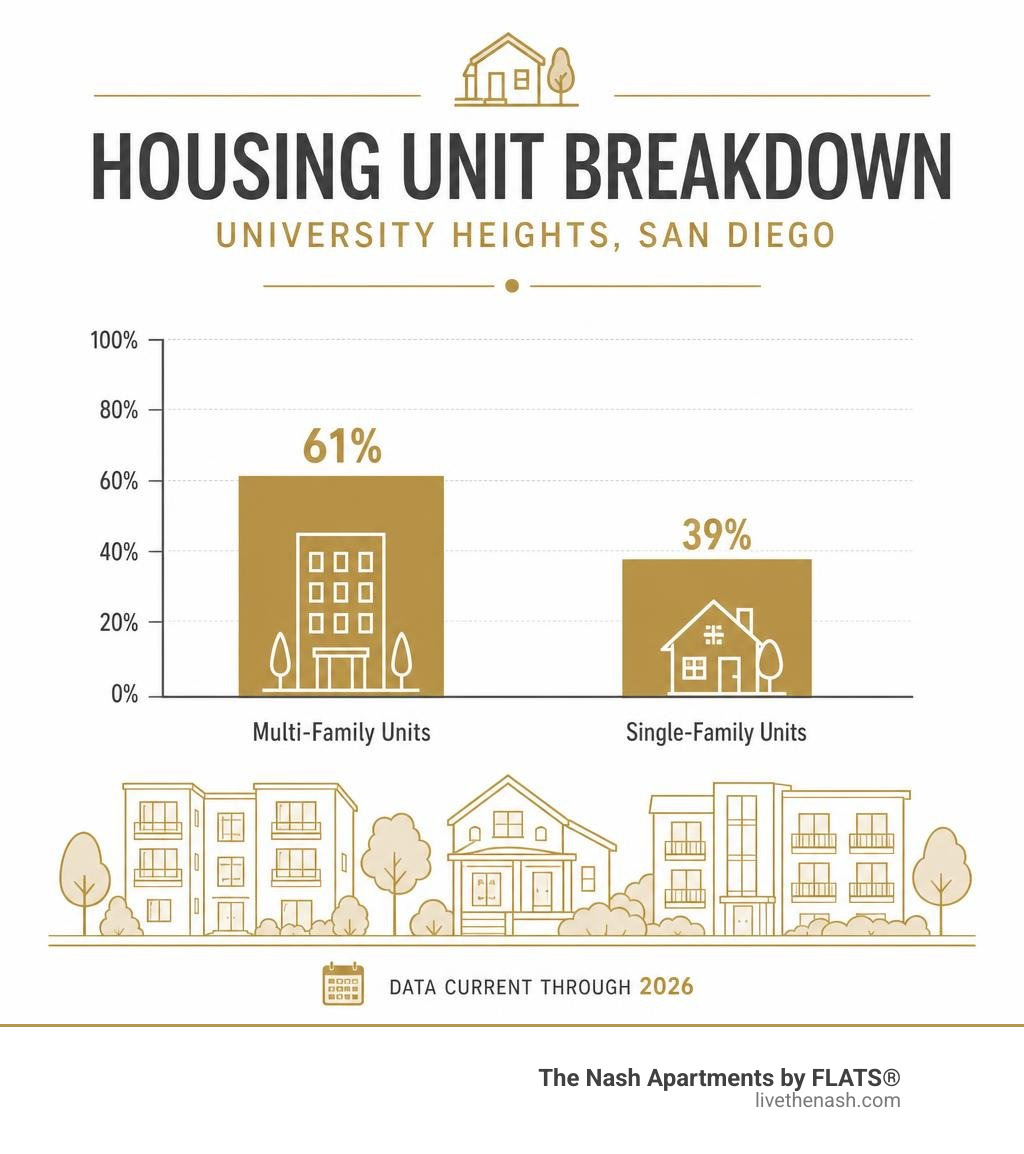
Housing in the neighborhood has evolved significantly. In 1950, the area contained 4,864 housing units. By 2020, that number had grown to 9,992 units. The current residential composition features a balance of multi-family developments and single-family properties:
Recent infill housing initiatives and the city's Complete Communities Housing Solutions program have accelerated new multi-family housing projects along major transit corridors. Additional housing capacity has also been added through accessory dwelling units (ADUs) built behind existing homes. For prospective residents exploring lease opportunities, check out our guides on Apartments at University Heights and Houses for Rent University Heights Guide.
Housing Stock and Multi-Family Living in University Heights San Diego
The residential architecture in university heights san diego blends historic craftsmanship with contemporary urban residences. From restored bungalow courts to modern mid-rise residential buildings, the options suit a wide variety of lifestyles.
| Architectural Style / Housing Type | Period Established | Key Characteristics | Neighborhood Presence |
|---|---|---|---|
| Craftsman Bungalows | 1900s – 1920s | Low-pitched roofs, exposed rafters, front porches, built-in woodwork | High concentration along quiet residential avenues |
| Spanish Colonial Revival | 1920s – 1930s | Stucco walls, red clay tile roofs, arched entryways, decorative ironwork | Prominent in historic cul-de-sacs like Shirley Ann Place |
| Bungalow Courts | 1920s – 1940s | Clusters of detached small homes facing a shared central garden walkway | Multi-unit residential pockets near Park Blvd |
| Modern Multi-Family Residences | 2000s – Present | Mid-rise structures, rooftop lounges, fitness facilities, structured parking | Concentrated along primary commercial corridors |
Modern multi-family buildings offer updated lifestyle features that complement the neighborhood's active street life. To read more about contemporary building features, explore our University Heights Apartment Amenities Guide 2026.
Frequently Asked Questions about University Heights San Diego
Why is the neighborhood named University Heights if no university is located there?
The neighborhood was named in 1887 during a San Diego land boom, when developers pledged land for a planned branch campus of the University of Southern California. Though that plan fell through when the land boom burst in 1889, the State Normal School (a teacher-training college) opened on the site in 1898. That school eventually grew into San Diego State University before relocating to Montezuma Mesa in 1931.
What are the geographic boundaries of University Heights?
University heights san diego is bounded by the Mission Valley mesa rim to the north, Lincoln Avenue to the south, Texas Street to the east, and borders Hillcrest near Park Boulevard to the west. It spans ZIP codes 92116 and 92103.
What historic features from the streetcar era remain today?
Remnants of the streetcar era include Trolley Barn Park (built on the site of the former 1913 San Diego Electric Railway car barn), rounded cobblestone walls along Adams Avenue and Mission Cliff Drive from Mission Cliff Gardens, and cobblestone pillars remaining from the original 1904 Bentley Ostrich Farm.
Finding Your Ideal Residence in University Heights
If you are looking to call this neighborhood home, The Nash Apartments by FLATS® offers modern luxury living right at the intersection of University Heights and North Park.
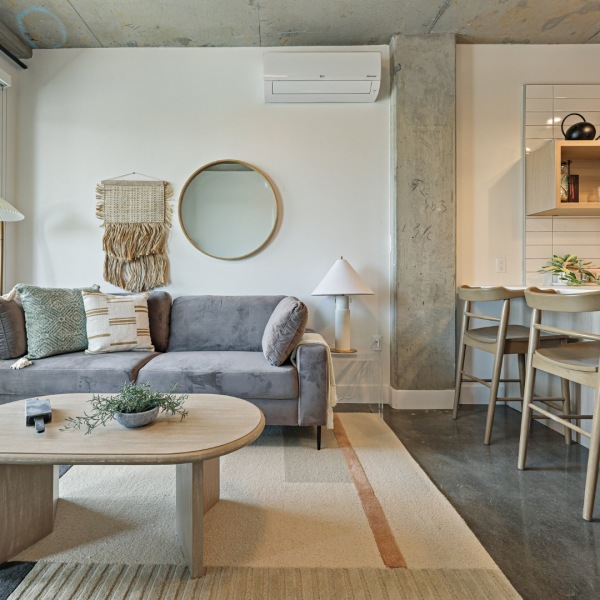
Our residential community features stylish floor plans with upscale finishes, designed to elevate your everyday experience. Residents enjoy access to premium on-site amenities, including:
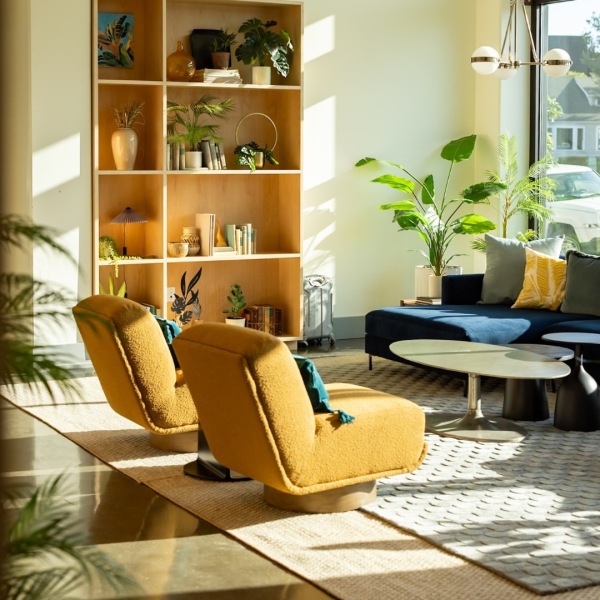
- A panoramic rooftop lounge with lounge seating
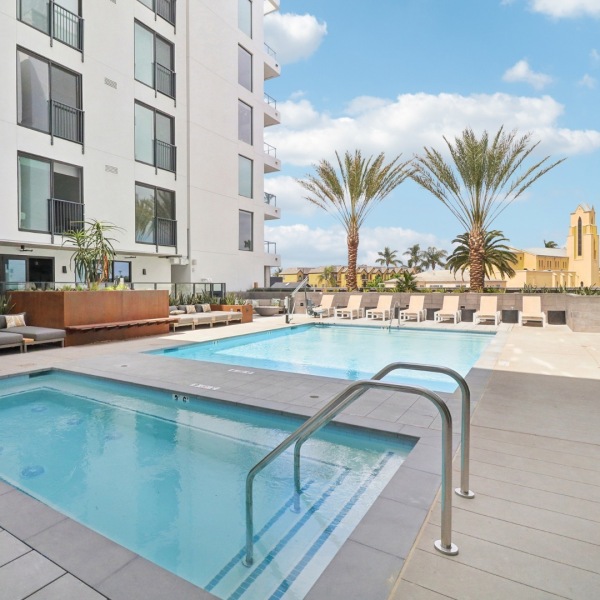
- A resort-style pool, hot tub, and private poolside cabanas
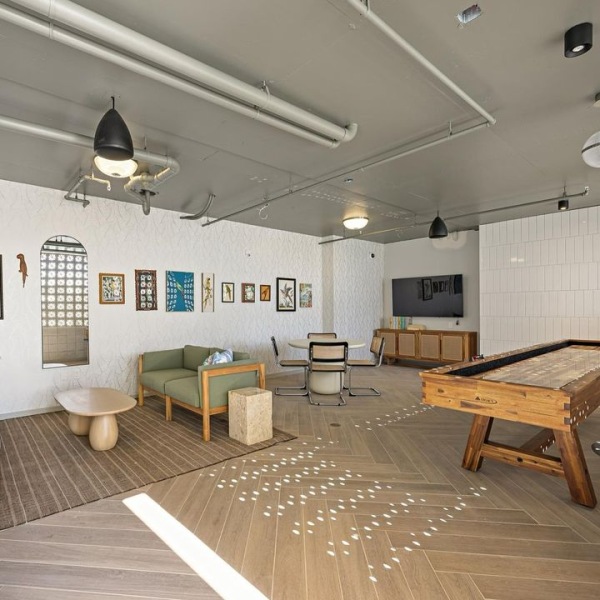
- An open-air game room and dedicated co-working lounge
- A comprehensive two-story fitness center
- On-site EV charging stations and thoughtful pet-friendly features (up to two pets per apartment)
Located with easy transit access to local dining, coffee shops, and cultural destinations, The Nash lets you experience the best of central San Diego living. Explore our full connection to Nearby San Diego Neighborhoods and read our complete University Heights San Diego Apartments Guide to find your next home today!