

Why Modern Apartments with Pool Tables Are Changing Urban Living
Apartments with pool table amenities are becoming the gold standard for urban living spaces that blend work, play, and social connection. These game-ready homes offer everything from compact 6-foot tables in studio lofts to full-sized slate tables in penthouse game rooms.
Quick Guide to Pool Table Apartments:
- Studio/1BR: 6-7 foot folding or convertible tables
- 2-3BR: 7-8 foot permanent tables with dedicated space
- Penthouses: Full-size 8-9 foot professional tables
- Community amenities: Shared game lounges and rooftop pool areas
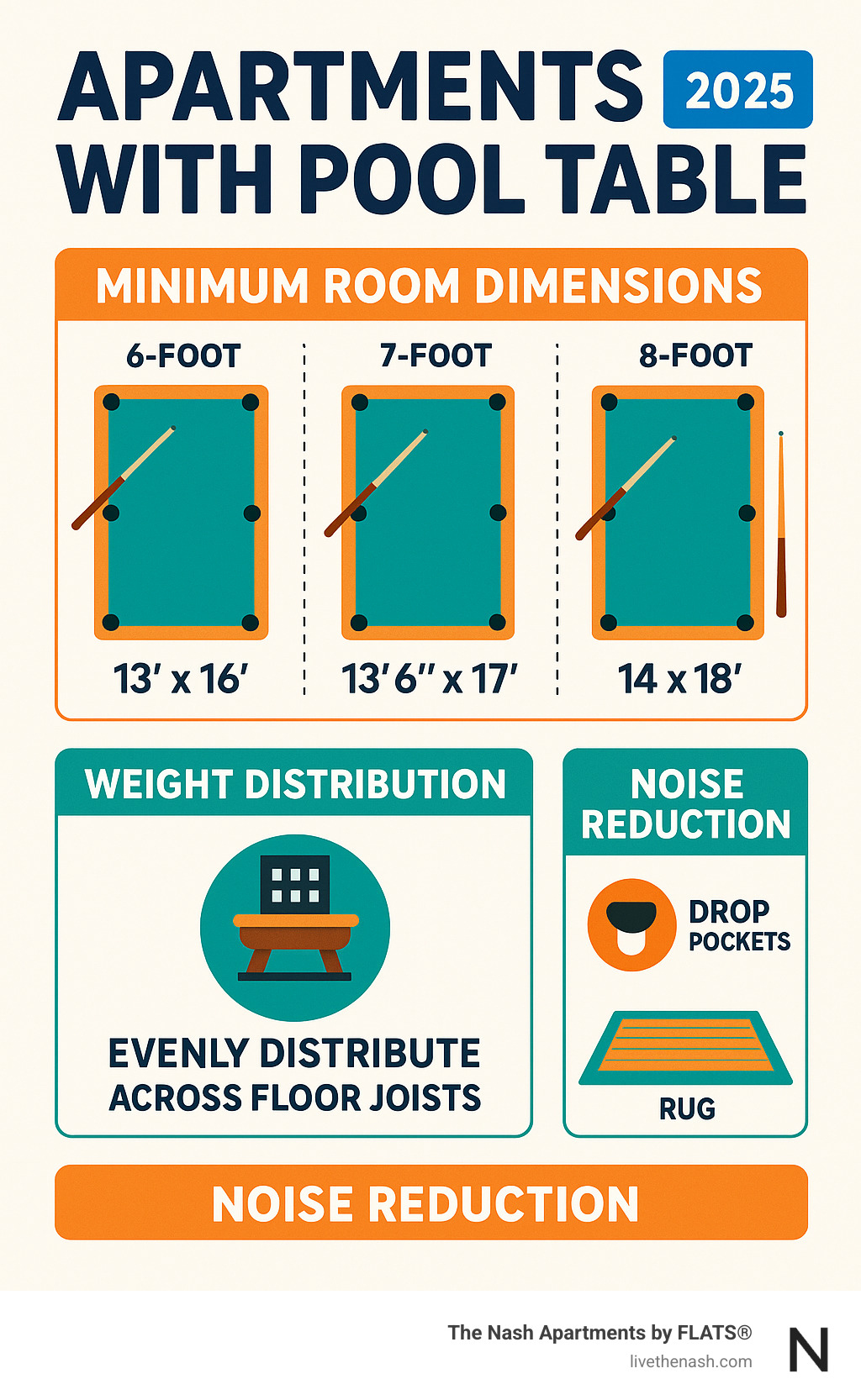
- Space needed: Minimum 13x16 feet for comfortable 7-foot table play
The trend makes perfect sense for busy professionals who want premium entertainment without leaving home. Modern apartment complexes are responding with creative solutions from convertible dining tables to community game rooms with professional Diamond tables.
For renters in vibrant neighborhoods like North Park or University Heights, having a pool table means hosting friends without expensive nights out. It's stress relief after long work days and a conversation starter that builds community connections.
Why a Pool Table Belongs in Your Apartment
Picture this: it's Friday evening, and instead of fighting traffic to find entertainment across town, you're hosting friends in your own space with a perfectly maintained pool table ready for action. Apartments with pool table setups offer something special that streaming services and takeout can't match - genuine connection and active fun.
Social bonding happens naturally around a pool table. Unlike passive entertainment where everyone stares at screens, billiards creates real conversation and friendly competition. The game breaks down barriers between new neighbors and gives introverted people comfortable conversation breaks between shots.
The stress relief benefits are immediate and measurable. After long days hunched over laptops, the physical movement of circling the table, bending for shots, and focusing on precise angles provides a perfect mental reset. Your mind shifts from work worries to calculating bank shots and planning your next move.
In-home entertainment means freedom from expensive nights out and crowded venues. No more driving across San Diego to find an available table or paying hourly fees that add up quickly. Your game is ready whenever inspiration strikes - whether that's a quick practice session before work or a weekend tournament with friends.
The fitness and focus benefits sneak up on you. Players often walk several miles during longer sessions, moving around the table to assess angles and line up shots. Each shot engages your core for stability while requiring precise hand-eye coordination.
Having quality entertainment amenities also boosts your property appeal significantly. Whether you're renting or own your unit, a well-maintained pool table makes your space the place people want to visit.
Health & Social Perks Backed by Data
The wellness benefits of regular pool playing extend far beyond casual entertainment, making it perfect for apartment living where every amenity needs to earn its space.
Mind-body coordination improves with every game. Each shot requires spatial reasoning to visualize ball paths, mathematical skills to calculate angles, and strategic thinking to plan several moves ahead. This combination challenges your brain in ways that can help maintain cognitive sharpness over time.
The cognitive boost comes from the game's unique blend of physics, geometry, and psychology. Players must read table conditions, adjust for felt speed, and anticipate their opponent's strategy. Research on recreational activities shows that games requiring these complex skills can provide measurable mental benefits.
Community building happens organically in spaces with pool tables. At apartment complexes with game rooms, residents report making more meaningful neighbor connections than in buildings without interactive amenities. The game serves as a natural icebreaker that works across different ages, backgrounds, and personality types.
For apartment dwellers specifically, having engaging activities at home eliminates the need for expensive entertainment elsewhere. The game pays for itself in saved nights out while providing unlimited access to stress relief and social connection.
Best Apartments with Pool Table Amenities
The landscape of apartments with pool table amenities has completely transformed how we think about home entertainment. What started as a luxury feature in high-end buildings has become a must-have amenity that smart developers are incorporating into everything from boutique complexes to sprawling resort-style communities.
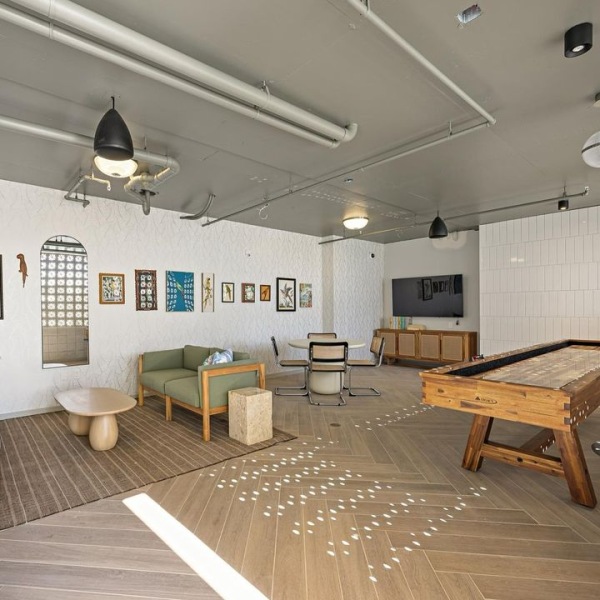
Community game rooms are leading this revolution. These shared spaces let residents enjoy professional-grade equipment without the headaches of ownership. Picture walking down to your building's game lounge and finding a perfectly maintained table with tournament-quality cloth, just waiting for your evening match.
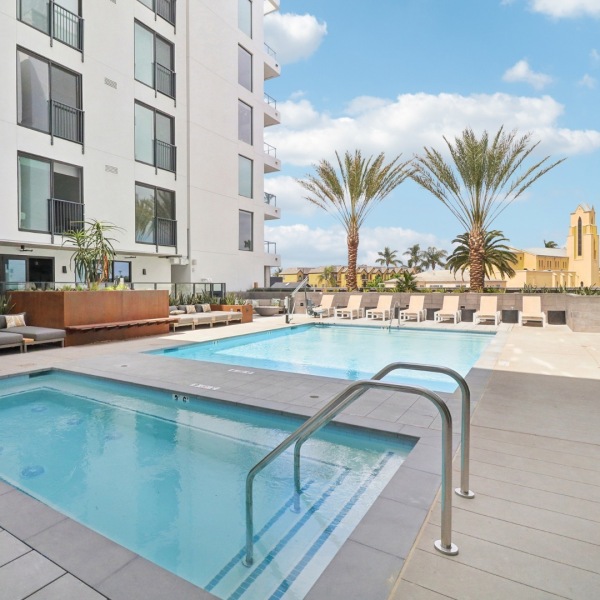
Rooftop entertainment areas represent another exciting trend that's particularly popular in places like San Diego where the weather cooperates year-round. These spaces combine stunning city views with premium gaming amenities. Some feature retractable covers that protect the equipment while maintaining that coveted indoor-outdoor living experience.
The co-working hybrid concept has really caught on too. These clever spaces serve double duty - professional work environment by day, entertainment hub by night. Tables with convertible tops make this possible, changing from conference surfaces during business hours to game tables when it's time to unwind.
Resort-style complexes are going all-out with multiple game zones. They might have casual bar-box tables near the pool area for quick games between swims, plus serious tournament rooms with full-size tables for those who take their billiards seriously.

Studio & Micro-Loft Options Featuring Apartments with Pool Table
Small spaces don't mean giving up on your pool dreams. The furniture industry has gotten incredibly creative with space-saving solutions that bring genuine billiards experiences to even the most compact living situations.
Bar-box 7-foot tables have become the go-to choice for studio dwellers who refuse to compromise on quality. These tables maintain the proper proportions that make pool enjoyable while fitting into spaces as small as 13x16 feet. The secret is pairing them with shorter cues and getting strategic about placement near walls.
Folding models have come a long way from those wobbly tables your friend had in college. Today's versions feature quality playing surfaces and solid construction that holds up to regular use. When game time ends, they fold flat against walls or slide under beds, instantly reclaiming your living space for daily activities.
Convertible dining tables represent the ultimate in multi-functional furniture. These ingenious pieces serve as your dining table, work desk, or coffee table when you're not shooting pool. High-quality versions use magnetic systems or mechanical locks to secure the dining surface, creating a completely stable work area that guests would never guess transforms into a game table.
Family-Sized Units and Penthouses Showcasing Apartments with Pool Table
When you have room to spread out, the pool table possibilities become truly exciting. Larger apartments and penthouses can accommodate the kind of setups that serious players dream about.
Eight-foot slate tables are where the magic happens for dedicated players. These tournament-specification tables deliver the authentic experience that makes every game feel professional. Yes, they're heavy - usually 650 to 800 pounds - but modern apartment construction handles this weight easily when it's properly distributed across the floor.
Dedicated game rooms transform pool from a casual activity into a serious pursuit. Proper lighting eliminates shadows that throw off your aim. Comfortable seating areas let friends watch and learn. Sound-dampening materials keep the neighbors happy while you perfect your break shot.
Professional installation becomes essential at this level. Three-piece slate tables require precise leveling and technical know-how that goes beyond typical furniture assembly. Many upscale complexes maintain relationships with table technicians who handle installation and ongoing maintenance.
Planning, Installing & Playing Smart in Small Spaces
Making a pool table work in your apartment takes some clever planning, but it's absolutely doable with the right approach. The secret is understanding your space limitations and working with them rather than against them.
Clearance calculations are your starting point. A typical 7-foot table needs about 13x16 feet of room to play comfortably with standard cues. But here's where it gets interesting - you can shrink those requirements down to roughly 11x14 feet by using shorter cues for tight shots. Many players actually prefer this setup since shorter cues can improve accuracy by eliminating awkward stretching.
Cue length hacks make all the difference in compact spaces. Professional cue makers offer quality sticks in 48, 50, and 52-inch lengths that feel balanced and natural while fitting your space constraints. Keep a few different lengths on hand so you can always make the shot, even when you're backed up against a wall.
Rug placement serves double duty in apartments with pool table setups. A thick rug under and around your table dampens sound for downstairs neighbors while protecting your floors from scuffs and dings. Make sure it extends at least 3 feet beyond the table on all sides.
Before you buy anything, check your lease clauses carefully. Most landlords want written notice before you install heavy furniture, especially something weighing several hundred pounds. Getting approval upfront prevents headaches later and shows you're a considerate tenant.
Measuring Space & Selecting the Right Table Size
Getting your measurements right prevents expensive mistakes and ensures you'll actually enjoy playing in your space. Start by measuring your room at its narrowest points, including any furniture, doorways, or other obstacles that affect movement around the table.
Room-size calculators take the guesswork out of planning. Players need comfortable movement space - cramped conditions turn fun games into frustrating experiences. The basic relationships work like this: 6-foot tables need minimum 11x13 feet with short cues, 7-foot tables require 13x16 feet with standard cues, and 8-foot tables demand 14x18 feet for comfortable play.
Wall-mounted racks maximize your floor space efficiency. Cue racks, ball holders, and accessory storage mounted on walls keep everything accessible without cluttering your playing area. Magnetic holders work great for chalk and other small items that tend to get lost.
Noise, Weight & Legal Considerations Before You Buy
Understanding the practical stuff upfront prevents problems after your table arrives. These considerations often determine whether a pool table will actually work in your specific apartment situation.
Live-load limits in residential buildings typically handle 40-50 pounds per square foot. A 650-pound table spread over a 4x8 foot area creates roughly 20 pounds per square foot - well within safe limits. Still, checking with building management shows you're being responsible and may be required by your lease anyway.
Noise-ordinance hours vary by city but usually restrict loud activities from 10 PM to 8 AM on weekdays and 11 PM to 8 AM on weekends. The break shot produces the biggest noise spike, followed by balls crashing into pocket collection systems. Plan your playing times around these patterns and everyone stays happy.
Landlord permission appears in most lease agreements for items that could affect other tenants or potentially damage property. Getting written approval protects you from disputes and might help negotiate accommodations like first-floor placement or soundproofing allowances.
Drop pocket modifications make a huge difference in noise control. These simple devices catch balls silently instead of letting them crash into collection areas. The modification costs under $50 and dramatically reduces the sound that travels to neighboring units.
More info about resident events
Creative Solutions & Alternatives When Space is Tight
When a traditional pool table just won't fit, innovative alternatives can still bring billiards into your small apartment space. These solutions focus on functionality and space efficiency while keeping the genuine playing experience intact.
Convertible dining tops offer the ultimate space-saving solution. High-quality systems use precision-fitted covers that transform your pool table into a dining table, work surface, or game table. Magnetic systems keep everything secure while allowing quick switches between functions - perfect for apartments with pool table features that need to multitask.
Folding legs let you store tables vertically against walls when not in use. Modern folding mechanisms maintain rock-solid stability during play while enabling compact storage. Some systems include wheels for easy movement between storage and playing positions.
Community game lounges in apartment complexes give you the best of both worlds - access to professional-quality equipment without personal space requirements. You get high-end tables, proper lighting, and social atmosphere without installation, maintenance, or storage challenges.

Moving, Assembly & Upkeep
Proper installation and maintenance keep your table playing like new while protecting your investment. Understanding these requirements helps you decide between DIY and professional services.
Professional versus DIY installation depends on your table type and comfort level with tools. Folding tables and simpler models usually come with clear instructions that handy people can handle. Slate tables, however, need professional installation to ensure proper leveling and optimal playing conditions.
Slate leveling demands precision and experience. Three-piece slate tables require micro-adjustments to create perfectly flat playing surfaces. Professional installers use specialized tools and techniques to achieve tournament-quality conditions that stay stable over time.
Cloth care extends your table's life and maintains playing quality. Regular brushing removes chalk dust and debris that can damage fibers and affect ball roll. Professional cleaning every 12-18 months removes embedded dirt and restores optimal playing conditions.
Cost & Maintenance Snapshot
Planning for a pool table in your apartment means understanding the full financial picture beyond just the sticker price. The investment includes everything from delivery logistics to ongoing care that keeps your table playing like new.
Purchase prices span a wide range depending on your needs and space constraints. Basic folding tables that work well in studios start around a few hundred dollars, while quality bar-box tables suitable for most apartments with pool table setups run into the low thousands. Professional slate tables that deliver tournament-quality play can cost several thousand more.
Delivery and setup costs add significantly to your budget, especially in apartment buildings. Professional delivery typically runs a few hundred dollars, with additional charges for challenging access situations like narrow stairwells or freight elevator requirements. Installation fees for slate tables requiring precise leveling can add several hundred more to your total investment.
Accessory bundles provide the best value for getting everything you need to start playing immediately. Quality starter packages include cues, balls, chalk, and basic maintenance supplies. Buying these items together typically costs less than purchasing individually and ensures everything works well together.
Replacement cloth represents your biggest ongoing expense. Professional re-clothing maintains optimal playing conditions and typically needs attention every few years with regular use. The investment pays off in consistent ball roll and maintained table value.
Resale value for quality tables from recognized manufacturers typically holds steady at about half the original purchase price when well-maintained. Keeping documentation of professional maintenance and original purchase information helps maximize return when it's time to sell.
The choice between DIY and professional maintenance affects both costs and playing quality. Basic cleaning and minor adjustments work fine as weekend projects, but major work like leveling adjustments and cloth replacement require professional know-how. Annual professional check-ups prevent small issues from becoming expensive problems.

Scientific research on equipment lifespans shows that proper maintenance significantly extends table life and maintains playing quality. Regular care protects your investment while ensuring every game feels as smooth as the day your table was installed.
Frequently Asked Questions about Apartments with Pool Table
How much space do I really need for a 7-foot table?
The honest answer might surprise you - apartments with pool table setups need less space than most people think. A 7-foot table works comfortably in a room that's 13 feet by 16 feet when you're using standard cues. But here's the game-changer: drop down to shorter cues (48-52 inches instead of the usual 57-58 inches), and you can squeeze that same table into an 11 by 14 foot space.
The math is pretty straightforward. Your table takes up 4 feet of width and 8 feet of length. The rest of that space is for you to move around and take shots without whacking the walls with your cue. Most players need about 2.5 to 3 feet of clearance on each side, and 4 to 4.5 feet on the ends.
Your playing style makes a difference too. If you're the type who likes dramatic, sweeping shots, you'll want maximum clearance. But if you prefer controlled, precise movements, tighter spaces work just fine. Many apartment dwellers actually find that shorter cues improve their game by encouraging more focused technique.
The key is being realistic about your space and honest about how you play. Measure twice, order once - and don't forget to account for that door you need to walk through.
Will the floor in my upstairs apartment hold a slate pool table?
Your floor can absolutely handle it. This worry keeps a lot of people from getting the table they want, but modern apartment construction is built for much more than a pool table's weight.
A typical 7-foot slate table weighs around 650 pounds. That sounds like a lot until you realize it's spreading that weight over a 4 by 8 foot area - only about 20 pounds per square foot. Apartment floors are designed to handle 40 to 50 pounds per square foot, so you're well within the safety zone.
Think about it this way: that weight is less concentrated than having a bunch of people standing around at a party. The table distributes its load evenly rather than putting all the pressure in one spot.
That said, it's smart to give your building management a heads up. Some leases require approval for heavy furniture, and showing consideration goes a long way toward maintaining good relationships. Plus, they might have helpful suggestions about placement or installation.
Professional installers know how to protect your floors while ensuring the table stays perfectly level. They use proper padding and techniques that keep both your table and your deposit safe.
How can I keep noise from disturbing my neighbors?
Nobody wants to be that neighbor - the one causing complaints and awkward hallway conversations. The good news is that a few simple modifications can make your pool table practically silent.
Drop pockets are your best friend here. Instead of balls crashing through the table's return system, they catch balls quietly in little fabric pouches. This simple upgrade costs under $50 and eliminates about 70% of pool table noise right away.
A thick rug under the table does double duty - it dampens sound going to the floor below while protecting your apartment's flooring. Make sure it extends at least 3 feet beyond the table on all sides to cushion your movement around the table too.
Timing matters as much as equipment. Most noise ordinances restrict loud activities between 10 PM and 8 AM on weekdays, with slightly later allowances on weekends. The break shot is by far the loudest moment in any game, so save your serious sessions for appropriate hours.
Soft table covers provide extra sound dampening when you're not playing. They also protect the playing surface and can double as dining surfaces if you have a convertible table setup.
The reality is that with these modifications and some consideration for timing, your neighbors probably won't even know you have a pool table. It's all about being thoughtful and proactive rather than reactive.
Conclusion
Having a pool table in your apartment isn't just about the game - it's about creating a lifestyle that brings people together right where you live. Apartments with pool table setups prove that you don't need a huge house or expensive nights out to enjoy premium entertainment and build lasting friendships.
The beauty of modern apartment living lies in finding creative solutions that work for your space. Whether you're working with a cozy studio that needs a folding table or a spacious unit that can handle a full-size slate table, there's a setup that fits. Community game rooms offer another fantastic option - all the fun of professional equipment without worrying about installation or maintenance.
What makes this trend so exciting is how it solves real problems. Instead of spending your evenings commuting to entertainment venues and paying premium prices, you get unlimited access to stress relief and social connection steps from your front door. Your apartment becomes the place friends actually want to visit, turning ordinary weeknights into memorable experiences.
The practical concerns that once made pool tables seem impossible in apartments have smart solutions now. Noise-reducing drop pockets keep neighbors happy. Shorter cues make tight spaces work. Convertible tables pull double duty as dining surfaces. Professional installation ensures everything works perfectly from day one.
Apartments with pool table amenities represent something bigger - a shift toward living spaces that support your whole life, not just your sleep schedule. Places like The Nash Apartments by FLATS® understand this completely. With features like rooftop lounges, open-air game rooms, and co-working spaces, they create communities where you can truly live large without leaving home.
The investment pays for itself quickly when you consider what you'd typically spend on entertainment. More importantly, it creates connections and experiences that make your apartment feel like a real home. In neighborhoods like University Heights and North Park, where community matters, having engaging spaces brings people together naturally.