

The Rise of EV-Friendly Apartments
Apartments with EV chargers are becoming an increasingly sought-after amenity in today's rental market. As electric vehicle adoption surges, renters need convenient charging solutions where they live.
"71% of EV drivers prefer to charge at their home." - Industry survey
Quick Guide to Finding Apartments with EV Chargers:
- Target newer luxury buildings - Fewer than 5% of rental properties currently offer EV charging
- Search early - Start your apartment hunt at least 10 weeks before moving
- Ask specific questions about charger type, access, and any additional fees
- Check compatibility between your vehicle and the available charging equipment
- Consider the value - 58% of renters are willing to pay more for this amenity
The electric vehicle revolution is changing how we think about apartment amenities. With EVs representing 8.6% of all vehicle sales in the U.S. and expected to grow significantly, charging infrastructure is becoming essential. This is especially relevant considering that over 44 million U.S. households live in rental properties, and over 80% of EV charging takes place at home or work.
What Is Apartment EV Charging & How It Works
Ever wondered how EV charging works when you live in an apartment? It's actually simpler than you might think! Apartments with EV chargers have become increasingly popular as more people make the switch to electric vehicles.
At its heart, apartment EV charging means having access to charging infrastructure right where you live. Unlike single-family homes where installation is straightforward, apartment charging requires thoughtful planning to serve multiple residents efficiently.
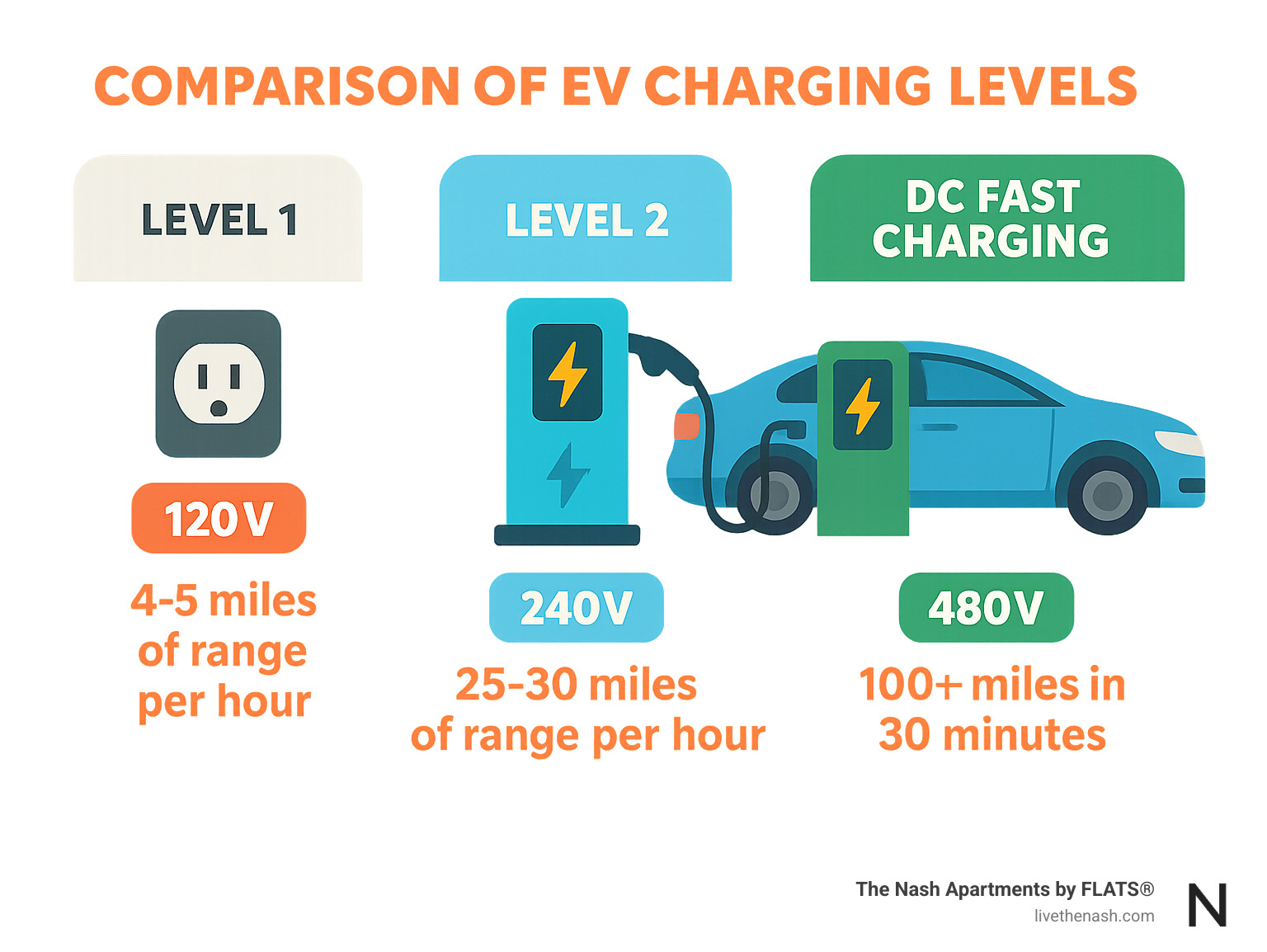
The simplest form starts with standard 120V outlets (Level 1 charging) in designated parking areas. But most modern apartment communities like The Nash are installing dedicated Level 2 charging stations that operate at 240V, giving you much faster charging speeds. You'll typically find these mounted on walls or pedestals in parking garages or designated EV parking spots.
Behind the scenes, smart load management systems control these chargers by balancing electrical capacity among multiple vehicles, adjusting charging rates based on building power demand, scheduling charging during off-peak hours, and tracking usage for billing purposes.
Many apartments implement time-of-use pricing that encourages overnight charging when electricity rates drop. This creates a win-win situation – residents pay less while the building avoids high demand charges during peak hours.
How Shared Charging Is Managed in Multifamily Lots
In apartment settings, managing shared charging requires balancing accessibility, fairness, and efficiency.
Assigned Charging Spots are a common approach. Some properties dedicate specific parking spaces with chargers to residents with EVs. These might be permanently assigned to specific units (often at a premium rent), reserved during scheduled charging windows, or available first-come, first-served among EV owners.
Community Chargers serve the entire building and typically use user-friendly management systems:
- RFID card access that identifies who's using the charger
- Mobile apps for reserving charging time slots
- Digital queuing that notifies the next person when a station becomes available
One of the coolest innovations is Power Sharing Technology, which allows multiple vehicles to connect to the same charging infrastructure simultaneously. The system intelligently distributes available power based on each vehicle's needs and the building's electrical capacity.
Safety Features Required for Apartment Chargers
When it comes to charging your EV at your apartment home, several important safety features are built into every proper installation:
Ground Fault Circuit Interrupters (GFCI) protect against electrical shock by detecting ground faults and quickly disconnecting power. This is essential for all EV charging stations, especially in shared parking environments.
Overcurrent Protection through dedicated fuses or circuit breakers prevents electrical overloading. These are specifically sized for each charging station's power requirements to prevent potential fire hazards.
National Electrical Code (NEC) Clearance Requirements mandate specific spacing around charging equipment. This ensures proper ventilation, accessibility for maintenance, and safe operation regardless of weather conditions.
Types of EV Charging Stations in Apartments
Finding apartments with EV chargers means understanding the different charging options you might encounter during your apartment hunt. Not all chargers are created equal, and the type available can significantly impact your daily EV experience.
Level 1 Charging
Level 1 charging is the most basic option, using standard 120V household outlets—the same ones you'd plug a lamp into. These provide a modest 3-5 miles of range per hour, delivering about 1.4 kW of power. While they require no special installation, they're best suited for overnight charging when your car has 8+ hours to sit, or for plug-in hybrids with smaller batteries.
Level 2 Charging
Level 2 chargers are the sweet spot for apartment living, operating on 240V circuits (similar to what powers your electric dryer). These chargers deliver 15-40 miles of range per hour at 7.2-19.2 kW, making them perfect for daily charging needs. While they require professional installation, they're the most common choice for dedicated apartment charging stations because they strike the perfect balance between charging speed and installation cost.
DC Fast Charging (Level 3)
DC Fast Chargers are the speedsters of the EV charging world, using direct current at 400-900V to deliver 50-350 kW of power. They can charge your battery to 80% in just 20-30 minutes, but you'll rarely find them in residential settings due to their high installation costs and significant electrical infrastructure requirements.

Most North American chargers use the J1772 standard connector for Level 1 and 2 charging. If you drive a Tesla, don't worry—your car comes with adapters that allow you to use these standard connectors alongside Tesla's proprietary ones.
Level 1 vs Level 2 vs DC Fast – Which Fits Your Lifestyle?
The ideal charging setup depends on your unique driving habits and vehicle. Here's how each option stacks up:
| Charging Level | Charging Time (Full Battery) | Cost to Install | Power Draw | Best For |
|---|---|---|---|---|
| Level 1 (120V) | 20-40+ hours | $0-$300 | 1.4-1.9 kW | Plug-in hybrids, short commutes |
| Level 2 (240V) | 4-10 hours | $500-$2,000 | 7.2-19.2 kW | Daily drivers, all-electric vehicles |
| DC Fast (480V) | 20-60 minutes (to 80%) | $20,000+ | 50-350 kW | Road trips, emergency charging |
If you drive a smaller EV with a 30-40 kWh battery and commute less than 30 miles daily, Level 1 charging overnight might be sufficient. However, if you're driving a medium to large battery EV and commuting more than 30 miles daily, Level 2 charging becomes essential.
Why Apartments with EV Chargers Are a Game Changer
Apartments with EV chargers are revolutionizing the rental landscape, offering a breath of fresh air for electric vehicle owners. This once-luxury amenity is quickly becoming a must-have feature as more drivers make the switch to electric.
Recent studies show that nearly 60% of renters are willing to pay more for communities that offer EV charging—and for good reason. Think about life without home charging for a moment. EV owners without this amenity face a constant juggling act:
They're mapping errands around charging station locations. They're sitting in parking lots waiting for their cars to charge. They're paying premium rates at commercial stations. And they're crossing their fingers that the public charger they're counting on isn't broken or occupied when they arrive.
Having a charger where you live eliminates these daily hassles. It transforms the EV ownership experience from one of constant planning to effortless convenience. This is particularly meaningful considering that over 70% of EV drivers strongly prefer charging at home.
The green factor can't be overlooked either. By making electric vehicles a practical option for apartment dwellers, apartments with EV chargers help create cleaner, quieter neighborhoods with improved air quality. This sustainability aspect resonates deeply with younger renters—nearly half of millennials and more than 40% of Gen Z residents are planning to make their next vehicle purchase an EV.
The writing is on the wall for property developers and owners: multifamily buildings will host 17% of all charging stations by 2030. What was once a distinctive luxury is rapidly becoming an expected standard.
Everyday Benefits of Apartments with EV Chargers
The perks of living in apartments with EV chargers go far beyond the obvious convenience factor—they can genuinely improve your quality of life in several meaningful ways.
Think about time—our most precious resource. The average EV driver who depends on public charging networks spends somewhere between 3-5 hours every month just finding, waiting at, and using public chargers. That's up to 60 hours a year you could reclaim by living at a place like The Nash, where charging happens while you're sleeping, cooking dinner, or enjoying your favorite show.
Your wallet will notice the difference too. The economics are compelling when you break down the costs:
Public fast charging typically costs 40-60 cents per kilowatt-hour. Public Level 2 charging runs around 20-30 cents. Meanwhile, home charging averages just 13-16 cents nationally. For the typical EV driver, this translates to yearly savings of $300-$600.
There's also the peace of mind that comes with charging in a secure environment. No more leaving your vehicle unattended in unfamiliar locations while you wait for it to charge.
Cost, Access & Apartment Search Strategies
Finding the perfect apartments with EV chargers takes some savvy searching and knowing exactly what to look for. With this amenity still relatively rare, you'll need a smart approach to land your ideal EV-friendly home.
Begin your apartment hunt at least 10 weeks before you need to move. This timeline gives you a comfortable cushion since fewer than 5% of rental properties currently offer EV charging infrastructure. In high-demand markets like San Diego, these units can get snapped up quickly.
Newer developments like The Nash are your best bet for finding quality charging options. Recently constructed buildings typically include EV charging as part of their forward-thinking amenity packages, often featuring smarter technology and faster charging capabilities than retrofitted older properties.
When touring potential homes, dig into the details of their charging setup. Different properties structure their EV charging in various ways:
- Some include charging as a free perk bundled with your rent
- Others use pay-per-use models (typically $0.15-$0.30 per kWh)
- Some offer monthly subscription plans for unlimited access
- Many use hybrid approaches with basic free charging plus premium paid options
Access systems vary widely too. You might find dedicated chargers assigned to specific units, first-come-first-served community stations, or sophisticated app-based reservation systems. Understanding how you'll access charging day-to-day makes a huge difference in convenience.
Don't take marketing claims at face value. A property advertising "EV charging" might have just one or two chargers serving hundreds of units. Ask pointed questions about the number of charging stations, typical wait times, and how they handle high-demand periods.
Key Questions to Ask Before Leasing Apartments with EV Chargers
Before signing on the dotted line for an apartment with EV chargers, arm yourself with these essential questions to ensure the charging setup truly meets your needs:
About charger availability: How many charging stations do you have compared to the number of units? What's the typical wait time during busy periods? Is there a waitlist system, and how does it work?
Technical details matter: Find out exactly what level of charging is provided—Level 1, Level 2, or DC Fast charging makes a huge difference in how quickly your car charges. Ask about the power output in kilowatts and confirm compatibility with your specific EV model.
Access and management systems: How will you actually use the chargers day-to-day? Do you need an app, RFID card, or special key? Can you reserve charging time in advance? Are there time limits on charging sessions?
Cost structure transparency: Get crystal clear on what you'll pay. Is charging billed per kilowatt-hour, per hour of use, or as a flat rate? Are there monthly access fees on top of usage charges? Is any portion included in your rent?
Installing & Funding Chargers: A Roadmap for Property Owners
Adding EV charging to your apartment community doesn't have to be complicated. If you're a property owner considering this increasingly popular amenity, here's a straightforward path to get you started:
Begin with a thorough assessment of your property. Survey your residents about their current or planned EV ownership, examine your electrical capacity, and identify the best locations for chargers. The sweet spot is usually in visible, accessible areas that won't require extensive trenching or electrical work.
Technical preparation is your next step. Work with an experienced electrician to complete a proper load calculation – this tells you whether your building can handle the additional power draw or if upgrades are needed. Select charging equipment that matches your residents' needs and your budget. Many property owners start with a few Level 2 chargers and expand as demand grows.
Don't forget the paperwork! Securing the right permits and ensuring code compliance is essential. Most cities have specific requirements for EV charging installations, including ADA accessibility standards. Your local utility company may also need to be notified or involved, especially for larger installations.
The financial aspect might be the most pleasant surprise. While installation typically costs between $2,000-$10,000 per charging port, numerous incentives can dramatically reduce your out-of-pocket expenses. Consider how you'll structure the charging service – will it be a free amenity, subscription-based, or pay-per-use? Each model has different implications for your return on investment.
According to the latest research on EV outlook, electric vehicles will represent 13-29% of new vehicle sales by 2050. Installing charging infrastructure now isn't just about meeting current demand – it's about positioning your property for the future.
Incentives & Rebates Landlords Should Know
The sticker price for EV charging installation might initially seem steep, but don't let that discourage you. A remarkable array of financial incentives can transform the economics of this investment:
Apartments with EV chargers qualify for substantial federal support through the Alternative Fuel Infrastructure Tax Credit, which covers 30% of installation costs up to $30,000. The Inflation Reduction Act has further expanded these benefits, making now an ideal time to invest. Don't overlook the depreciation benefits for business-owned charging equipment, which can improve your tax position.
California property owners enjoy particularly generous support. Programs like the California Electric Vehicle Infrastructure Project (CALeVIP) and San Diego Gas & Electric's Power Your Drive initiative offer significant funding for multifamily properties. Local air quality management districts frequently provide additional grants specifically targeting apartment communities.
Frequently Asked Questions about Apartment EV Charging
How much does it cost to rent an EV-ready unit?
Looking for apartments with EV chargers often means paying a bit more – but for good reason. These tech-forward units typically command a 3-7% premium compared to similar apartments without charging access.
This premium reflects both the valuable infrastructure investment by the property and the tremendous convenience it provides. When you consider that 71% of EV drivers prefer charging at home, and that public charging stations typically cost 30-50% more than residential charging, the math starts to make sense for many drivers. The time saved from not hunting for public chargers is just icing on the cake!
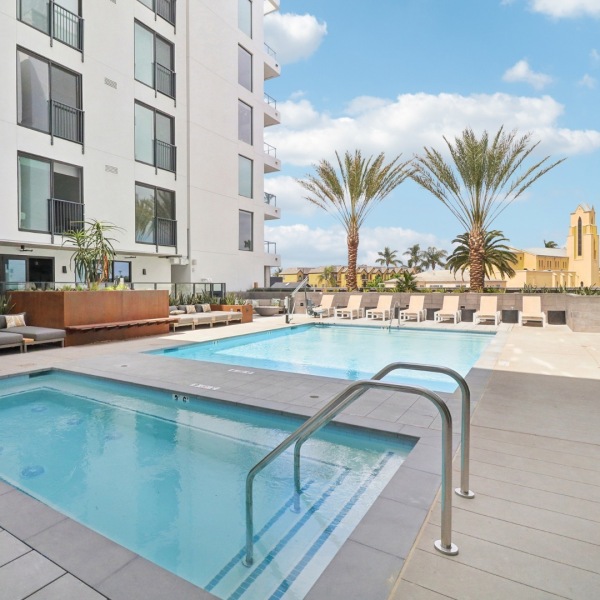
At The Nash, our EV-ready apartments are seamlessly integrated into our comprehensive luxury amenity package. Residents enjoy not just convenient vehicle charging but also access to our stunning rooftop lounge, refreshing pool and hot tub, and state-of-the-art two-story fitness center – all designed to deliver exceptional value.
Are there extra fees for using on-site chargers?
When it comes to charging costs at apartments with EV chargers, the approaches vary widely. Here's what you might encounter:
Some luxury properties include unlimited charging as part of your monthly rent – no extra fees to worry about. Others implement a straightforward pay-per-use model with networked chargers that track your individual electricity consumption (typically $0.15-$0.30 per kilowatt-hour).
Many buildings offer subscription models with a flat monthly fee for unlimited charging, while others take a hybrid approach with some included charging and additional usage billed separately. You might also find time-based fees designed to encourage turnover and fair access when charging stations are limited.
When touring potential apartments, be sure to ask not just whether charging is available, but also about the specific cost structure and how it aligns with your typical charging habits.
What if my building doesn't have EV chargers yet?
Found your dream apartment but no charging infrastructure in sight? Don't despair – you have options!
Start by mapping nearby charging alternatives. Look for public stations within walking distance, workplace charging on your commute route, or options at places you frequently visit. This patchwork approach isn't ideal but can work as a temporary solution.
Consider becoming an advocate for charging at your building. Approach management with a thoughtful proposal highlighting resident demand – gather signatures from fellow EV enthusiasts to strengthen your case. Property managers are often unaware of the generous incentives and rebates available that can offset 50-80% of installation costs.
If you have an assigned parking space near an outlet, you might request permission to use it for basic Level 1 charging with appropriate billing arrangements. Even simple 120V outlets can provide enough power for many commuters' daily needs.
Conclusion
The world of apartments with EV chargers is changing fast as more Americans accept electric vehicles. What was once seen as a luxury perk is quickly becoming a must-have feature for modern apartment communities. With only about 5% of rental properties currently offering EV charging, buildings that provide this amenity enjoy a real edge in attracting and keeping happy residents.
Looking ahead, experts predict that apartment buildings will account for 17% of all charging stations by 2030. This growth reflects both increasing demand from renters and property owners recognizing the value of investing in charging infrastructure. For EV owners who rent, this trend promises greater accessibility and convenience, making electric vehicle ownership practical regardless of whether you own your home.
Living in an apartment with reliable EV charging delivers benefits that go well beyond simple convenience. Residents enjoy meaningful cost savings compared to relying on public charging networks, better security for their vehicles, and the satisfaction of supporting greener transportation options. With research showing that 58% of renters are willing to pay more for this feature, the value is clear for both residents and property owners alike.
If you're currently hunting for an apartment that supports your EV lifestyle, remember to start your search early, ask detailed questions about charging specifications and access policies, and verify compatibility with your specific vehicle model. For those whose current buildings don't offer charging, don't give up hope – thoughtful advocacy efforts often yield positive results, especially when multiple residents demonstrate interest.
At The Nash, we're proud to be leading this evolution in apartment living. Nestled between San Diego's vibrant University Heights and North Park neighborhoods, our community offers not just cutting-edge EV charging but a complete collection of modern amenities. From our stunning rooftop lounge and refreshing pool to our cozy poolside cabanas and impressive two-story fitness center, we've created a living experience that meets today's lifestyle needs.
Ready to learn more about our amenities and schedule a tour of our EV-ready community? Visit our amenities page to see everything The Nash has to offer.